
White Elephant Stadium
Boston deserves a successful women's pro soccer team. White Stadium will prevent that from happening.

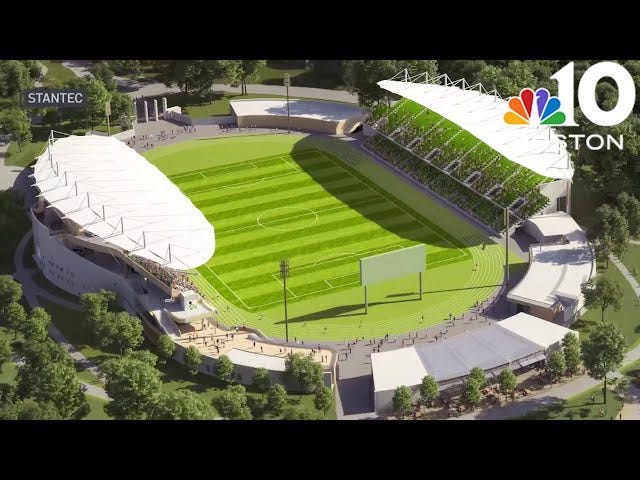
Kudos to the Boston Legacy! In their first season, they’ve managed to put a competitive team on the field and draw good crowds and energy to Gillette and Centerville Bank Stadium (RI). It would be a shame if this great start did not carry over into Boston’s first enduring women’s professional sports franchise.
Boston has never had a women’s sports team with a large fan base, pro or college. Many large cities have WNBA teams. Universities in the SEC, Big Ten, Big 12, and ACC routinely draw 4,000+ fans to basketball, volleyball, and softball games. Our local D1 women’s basketball teams draw crowds in the 100’s, unlike the UConn women who averaged 12,635 fans last season (by comparison, the BC women’s team averaged 865 fans).1 Boston needs this. It’s time for women’s sports to emerge from the large shadow cast by Boston’s many male teams.
Unfortunately, the plan to move the team to Boston’s White Stadium goes against the most fundamental elements of athletic facility design - lessons learned and improvements made over the past century.
I’m not going to opine on the transportation plan, alcohol policies, or important neighborhood issues regarding White Stadium. I’m simply offering an expert opinion on and history of professional soccer stadiums and how and why they succeed or fail.2
BOSTON’S PRO SOCCER HISTORY
For over 50 years, Boston tried and failed to support many a local soccer franchise. Men’s teams called the Astros, Minutemen, Tea Men, Bolts, and Storm all fizzled out after a couple years.3456 The women tried two iterations of the Breakers – both quickly came and went.7 There are a myriad of reasons why these attempts at pro soccer failed. One common issue was lack of an adequate stadium. Most teams gave it a go at BU’s Nickerson Field. While it has 10,000 seats, it’s not suited for soccer as most fans sit high and far from the field – a fact acerbated by the running track which rings the field. Football stadiums at Harvard and BC and glorified high school fields like Bowditch Field (Framingham) and Sargent Field (New Bedford) also hosted these pro teams.
SOCCER STADIUMS USA
Early Major League Soccer stadiums were a hodgepodge collection of facilities. Some, like Ohio Stadium (Columbus, OH), had over 90,000 seats while others had fields lined through dirt baseball infields.
Soccer in America truly changed with the construction of the country’s first ‘soccer specific stadium’. Columbus Crew Stadium was built in 1999 with two purposes in mind – to be a great place to play and watch soccer.89 It was intimate – its 20,000 seats close to the field. Unlike many football stadiums, it allowed for the proper width soccer field. And, because it was not being used for other sports like football and baseball, the playing surface was pristine.
Since Columbus Crew Stadium opened, dozens of other soccer stadiums have been built in the US. None include a running track. The NFL does not have any stadiums with a field inside a running track as the LA Coliseum once did. In the top 6 tiers of England professional soccer, not one of the 142 stadiums has a running track. Nothing kills the atmosphere of a soccer match more than a running track pushing fans far away from the action.
THE LESSONS OF BASEBALL PARKS
100 years ago, many MLB teams played in wonderful intimate stadiums crammed into urban neighborhoods. They were affectionately called ‘jewel box’ baseball parks. Most of these baseball temples, including Ebbets Field (Brooklyn) and Shibe Park (Philadelphia), went the way of the wrecking ball. Today, only two remain – Fenway Park and Wrigley Field.10
Post World War II, people left the cities in their new cars for suburbia. These same people comprised much of the fan base for MLB teams. Unfortunately, most of the old baseball parks were not easily accessible by car, didn’t have ample parking, and did not have subway access. People stayed home. Fenway and Wrigley had good access to public transportation and survived.
The lesson - no matter how nice the stadium, if it’s not easily accessible by car or public transportation, people won’t come.
In the 70’s, multi-purpose ‘spaceship’ stadiums replaced these charming parks. St. Louis, Philadelphia and Pittsburgh built giant cookie cutter facilities to serve both their professional baseball and football teams. These facilities served no one well. They were too big and impersonal for baseball and had bad viewing for football.
The end of multi-purpose stadiums began with the building of the Baltimore Orioles’ Camden Yards, the first of the retro baseball-only parks in which most MLB teams play.11 There are no longer any NFL and MLB teams sharing a field.
The lesson - a stadium must be built for one main purpose, otherwise it will serve no one well.
WHITE STADIUM
For sure, the stadium needs to be renovated. It’s decades overdue.12 However, too many compromises were made in order to push the White Stadium / Boston Legacy project through. In the end, it will serve neither the Legacy nor city students and schools well.
Transportation There’s very little parking and no subway or commuter rail access. This is exactly what doomed many of the old baseball parks, including Boston Braves field (now BU’s Nickerson Field).13
The Running Track Nothing kills the atmosphere of a soccer match more than a running track. It pushes people far away from the field. Just look at West Ham United in London, who jury-rigged the 2012 Olympic track venue into their new soccer stadium.14 It typically ranks as the worst stadium in the Premier League.15 The Italian club Juventus had similar issues with its ill-fated hybrid soccer-track stadium. Here’s a great video on that stadium and why you don’t build soccer stadiums this way. Demolition Stadio delle Alpi (Juventus FC) | TFC Stadiums
White Stadium should have been developed just like Centerville Bank Stadium (RI). 10,000 seats, intimate, no track, built specifically for soccer with fans right next to the action.16
Grass Surface Most pro soccer teams around the world play on grass, not artificial turf. However, a grass field cannot also serve as a multi-purpose venue. It’s impossible. If you want to have ‘Fenway Park’ quality grass, you need to restrict access. There is no grass soccer stadium in the US which also serves as a general-use public facility. Not a one. San Francisco’s Kezar Stadium is a 10,000 seat public venue with a grass field and running track. Access to the grass field is severely limited. It has also been the home of over a half-dozen pro soccer and lacrosse teams. Nearly all folded within one year.17
Providence Park in Portland, OR is the best soccer-specific / general use stadium in the country. There’s one important reason why – its field surface is artificial turf. That would allow the field to be used for state high school championships, concerts, soccer, football and lacrosse games – you name it. Both the Portland MLS and NWSL teams have among the best attendance and atmosphere in their respective leagues. It works.18
In order for White Stadium to serve as a pro soccer venue AND a public-use facility, the playing surface MUST be artificial turf. Otherwise, Boston students will get to play a few soccer games on the field – that’s it. No lacrosse, football or field hockey. And what will happen when it rains? Will school soccer games be cancelled to protect the grass?
Boston residents will pay over $100 million for the White Stadium renovation. There’s expensive infrastructure being built – new training, fitness, and locker rooms will serve BPS athletes.19 However, since there will only be a running track and one grass field for occasionally use, very few students will actually be on site practicing and playing games. Thus, few students will be using those other support facilities.
For the project to have any chance of success, it needs to be redone. Three main things need to happen:
The track must be removed from the stadium. This will better serve the Legacy, BPS students and the local community.
The Playstead area just south of White Stadium should be incorporated into the plan (see diagram) and redeveloped into a sports facility with numerous fields and a running track.
That will allow the overall area to be a hub of BPS sports, drawing large numbers of students and teams every day. It will allow the other infrastructure (training, fitness, locker rooms) to get good daily use.
The White Stadium field surface must be artificial turf. Otherwise, BPS students will get virtually no access. Just follow the examples in Rhode Island and Portland, OR.

TWO STADIUMS
Boston has never had a soccer-specific stadium. Now, it’s going to have two. In addition to White Stadium, the Revolution are building one in Everett.20 I know the Legacy ownership group wants control over revenue streams and access to good playing dates. In short, they don’t want to be second fiddle to a men’s team. Fair and understandable.
I would think Governor Healy and Mayor Wu could exert influence to ensure the Legacy is not second fiddle at the Everett stadium. Boston does need a soccer stadium, but not two…and certainly not at the cost of $135 million public dollars. If Portland, OR can support two thriving, successful pro soccer franchises in one facility, Boston should be able to as well (in fact, nine MLS and NWSL teams share a stadium).
IN CLOSING
Boston deserves a women’s pro soccer team. We have no WNBA team. Unlike in other parts of the country, our D1 women’s college teams barely make a ripple in Boston’s large sports pond. So far, the Legacy have done so many things right and made terrific capital investment (including a practice facility in Brockton).21 It would be a shame if women’s pro soccer in Boston failed again because fundamentals of facility planning were ignored in the rush to build a stadium. It’s not too late to get it right.
I’ve worked on a wide variety of municipal and collegiate athletic facilities projects from Ohio Stadium to San Francisco’s Beach Chalet. I presently run an athletic facilities planning firm in Massachusetts - SC Sporting.
I was at Schaefer Stadium to watch Pele play the Minutemen in 1976. Pele, Chinaglia Lead Cosmos To 2-1 Win Over Minutemen | Sports | The Harvard Crimson
My u12 Duxbury youth soccer team played a pre-game match at Nickerson Field before a Tea Men match in 1978.
I personally played for the Boston Storm in 1994.
I worked for the Columbus Crew from 1999-2001. During this period, the stadium hosted numerous national team games and the 2000 NCAA Final Four.
In the 50’s, my father played football and my mother cheered at White Stadium as students at Hyde Park HS.
My father was a Boston Braves fan and took several trolleys from his Hyde Park home to reach Braves Field on Commonwealth Ave.
One other detail about the plan. Boston is paying for and able to use the West Grandstand for its events. That means fans will be staring directly into the afternoon / 4pm sun. Every facility at BC and Harvard - the fans face east, with the sun at their back.